Highland Canine Training, LLC

Old Dogs, New Tricks

February 5th, 2010

For Jason Purgason, few dogs are bad dogs. They just haven’t been well trained.

Purgason, a certified K-9 and SWAT instructor who was the first law enforcement dog handler in Rockingham County, says most every dog can be a friend and companion, while special breeds can perform specialized jobs for law enforcement.

So why are some dogs considered anti-social, suffering what he calls “a socialization deficit?”

Most often, he thinks the problem is more with the human in the dog’s life.

“The hardest part of this whole job is training people,” Purgason said Thursday during a training session with Lucy, a Great Dane, and her Statesville human, Sandy Murdock.

Murdock found Lucy as a stray over three months ago, and wanted to save her.

“She was a stray, she was not spayed. I think she was afraid of everything,” Murdock said.

The result? A dog that first tries to scare humans away as a result of her own fear.

“Fear-aggressive dogs don’t want to bite,” Purgason said.

“They want you to back off” so they growl and bark and it usually works.

“That conditions them, so they keep doing that,” he said.

“People in America look at dogs as humans in fur coats,” he said. “But they’re not. They have their own behaviors, and we try to make them fit ours. So maybe they have issues of dominance,” he said, and the dog’s way to address it is to tell the human “back off.”

The problem isn’t just with large dogs, he said. “We deal with behavioral issues in everything from Chihuahuas to Great Danes,” he said, displaying fear aggression.

With Lucy, Purgason initiated a course of direction that makes the dog pay attention to Murdock rather than reacting to everything else, which could be distractions like other humans or other dogs.

“This is wonderful,” Murdock said as she put Lucy through her paces, which involved reinforced training on sitting, staying and coming.

Serious work

But pampering pet owners is not Purgason’s main goal. As a certified police canine trainer through the U.S. Police Canine Association, the International Police Working Dog Association and Eastern States Working Dog Association, he strives to provide law enforcement with working dogs with well-rounded police skills.

“I’ve trained dogs for (law enforcement) in Wilkes County, Salisbury, Alexander County, the Federal Reserve Bank in Jacksonville, Fla., and the Miami Police Department,” he said.

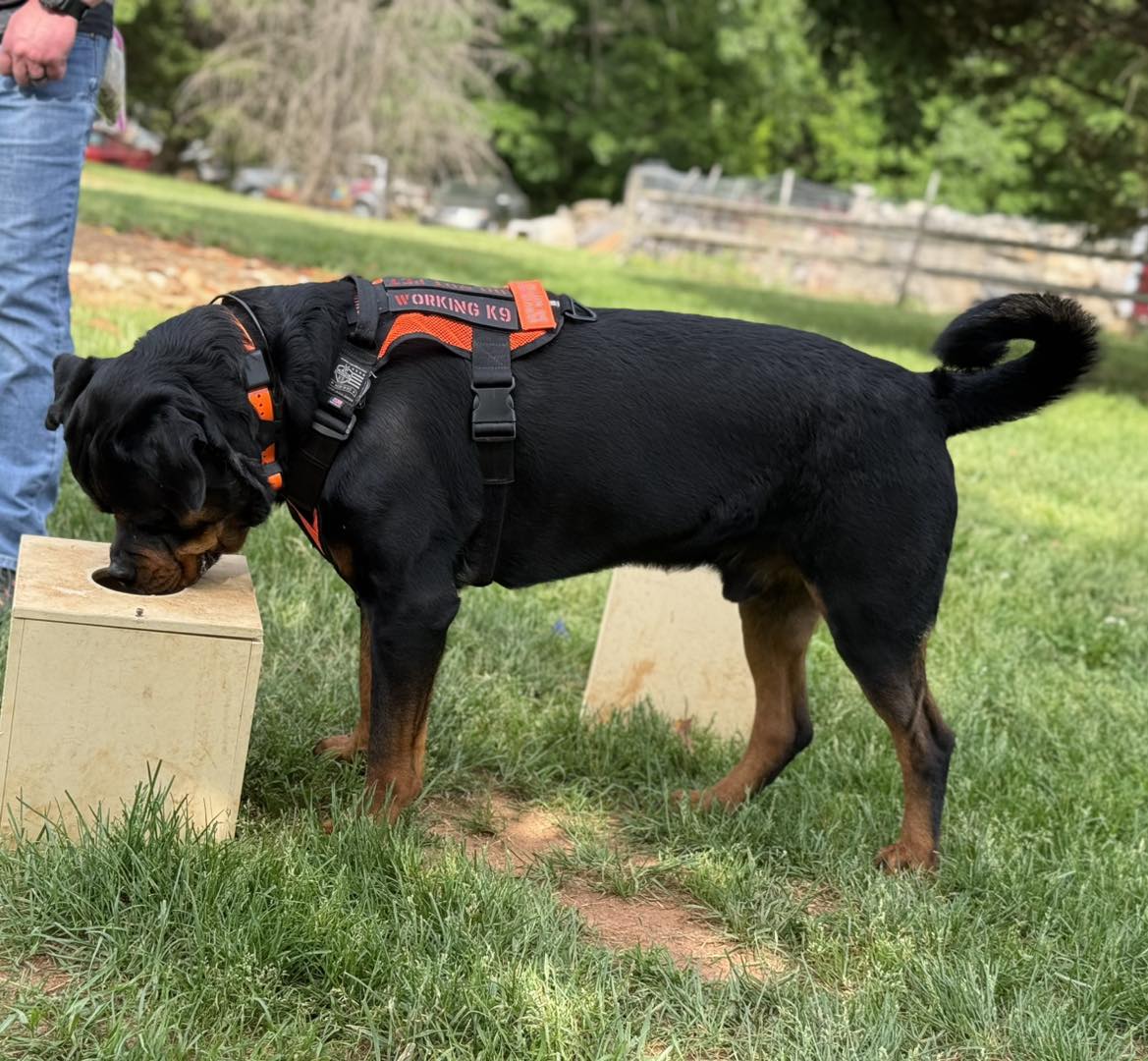
He chooses certain breeds for police work, and can provide turn-key canine officers for police patrol duty, search and rescue, human remain detection and personal protection. Those that do patrol duties are trained in handler protection, narcotic and explosive detection, building searches, human tracking, evidence searching, and, well, “to catch the bad guys,” Purgason said.

And he and his team of trainers say it’s a joy to work with the dogs. “It’s not a job because we have so much fun,” he said with a laugh.

Their last chance

Perhaps Purgason’s most critical mission is his pro bono work with aggressive dogs in local shelters. Most angry dogs that come to the shelter never have a chance for adoption because of their attitude.

“We understand that a majority of animals that are in shelters and rescues are often likely not to be adopted,” he said.

His solution is the Second Chance Program. What that means is he takes an aggressive dog from an animal shelter and puts it through an intensive program of training and behavior modification at no charge to make it more adoptable.

He will train the dog for three to six weeks, and then help find a family to care for the dog. “Once a family is selected, we take the time to work with them and their new dog to make sure that they understand their training, how to handle them effectively, how to reward them and correct any mistakes properly,” he said. “We also assist them in integrating the dog into their new home and offer free follow-up lessons to ensure that their new dog maintains their training.”

And he wants to take on the hard cases. “We are up for the challenge to take on the most difficult dogs,” he said.

“There are dogs we can’t fix,” he admitted. “But not many; none that I have seen.”

Which to Purgason means one fewer dog euthanized, and one more loving family companion.

This story can be found at: http://www.statesville.com/servlet/Satellite?pagename=SRL/MGArticle/SRL_BasicArticle&c=MGArticle&cid=1149192529152

You Want Me to Do What?

February 5th, 2010

Great dog teams fail because the dog is expected to do something that he has not previously been conditioned to do in training. With that said, you should never expect your dog to perform a task well if he has never been trained to do so.

This is often seen in detection work. For example, a handler is called by another officer to search a tractor trailer that has been stopped on the interstate. Without proper conditioning and training, this encounter can soon be a disaster for the dog team. A lot of handlers rarely train theirs dogs around tractor trailers and other types of large commercial vehicles. I believe that there are several reasons for this. Some handlers do not have access to vehicles of this type. Others are a bit intimidated by these vehicles because they have never been exposed to them or been taught how to properly conduct searches of them. Needless to say, if trained to search commercial vehicles effectively, the rewards can be phenomenal.

This failure is also seen regularly with police dogs and SWAT or Special Response Teams. Very few departments allow ample time and resources for their canine handlers to train with SWAT or tactical teams. However, when there is a need for a canine in a SWAT situation, the dog and handler are expected to perform with perfection. I often observe this when teaching Basic Police Canine and SWAT seminars. Dog teams are being integrated with SWAT teams and have never been exposed to munitions, rapid gunfire, or even their handler or other team members in full gear. Police canines can be successfully integrated into SWAT or tactical teams with some work, training and team support.

I also see a number of patrol dogs that are simply trained to react aggressively to the sound of gunfire. A typical training session goes like this; a “suspect” in protective equipment is placed out in a field and shoots in the direction of the dog or handler. The dog is then sent to bite them and the process is repeated. This leaves us with several questions to ask: How realistic is this training? What happens when the handler returns gunfire with a dog that has been conditioned to bite anyone who shoots? What if the suspect is hiding under a car and shooting at the team?

So, how do we properly condition and train our dog for those situations that we are likely to encounter in the field? Through Realistic Training! With a little effort and aforethought we can establish realistic training for detection, patrol, tracking and all other aspects of canine utilization. By conducting training that is productive and realistic we are able to appreciate the dogs strengths and scrutinize areas of deficiency in the dogs training. We are then able to correct any deficiencies that we observe, making for a more productive and effective canine team.

If you would like to discuss training problems or are interested in our seminars please call 866.200.2207 or email training@highlandcanine.com

When One Door Opens…

February 5th, 2010

I recently had a client in Charlotte, North Carolina who called about a dilemma with her terrier. She stated that the dog was great around the house, for the most part, but was having issues when company arrived and when she took the dog outside. She explained that whenever someone knocked or rang the doorbell the dog would tear at the door and attempt to attack them, acting in a very aggressive manner. Once the person came in, the dog would bark non-stop for hours, or until they left, whichever came first. When she attempted to take the dog for a stroll, around her fairly busy neighborhood, she would exhibit a very similar behavior. She would bark at neighbors, lunge at other dogs and loud cars and try to attack people taking out their trash. The owner had previously completed basic obedience training with the dog, hoping this would help. She stated that she had already employed the service of two other trainers and had even consulted with a dog behaviorist, to no avail. She was extremely concerned that her dog would bite someone.

I met with the owner and her disturbed dog to evaluate the situation. Even before I entered the house the dog was barking furiously and charging at the door. It was obvious that the dog was very uncomfortable with this situation. I soon learned that the dog had grown up with a breeder and the current owner had purchased her at about a year old. This behavior had been going on for some time and seemed to be getting even worse.

So, I was faced with the task of disentangling this unusual behavior and discovering its source. We started obedience training with the dog and began to work on her unacceptable behavior. Her previous obedience lessons had only covered the initial phase of training, the teaching phase. This caused her obedience to be rather inconsistent when calm and non-existent, to say the least, when she was on a tirade.

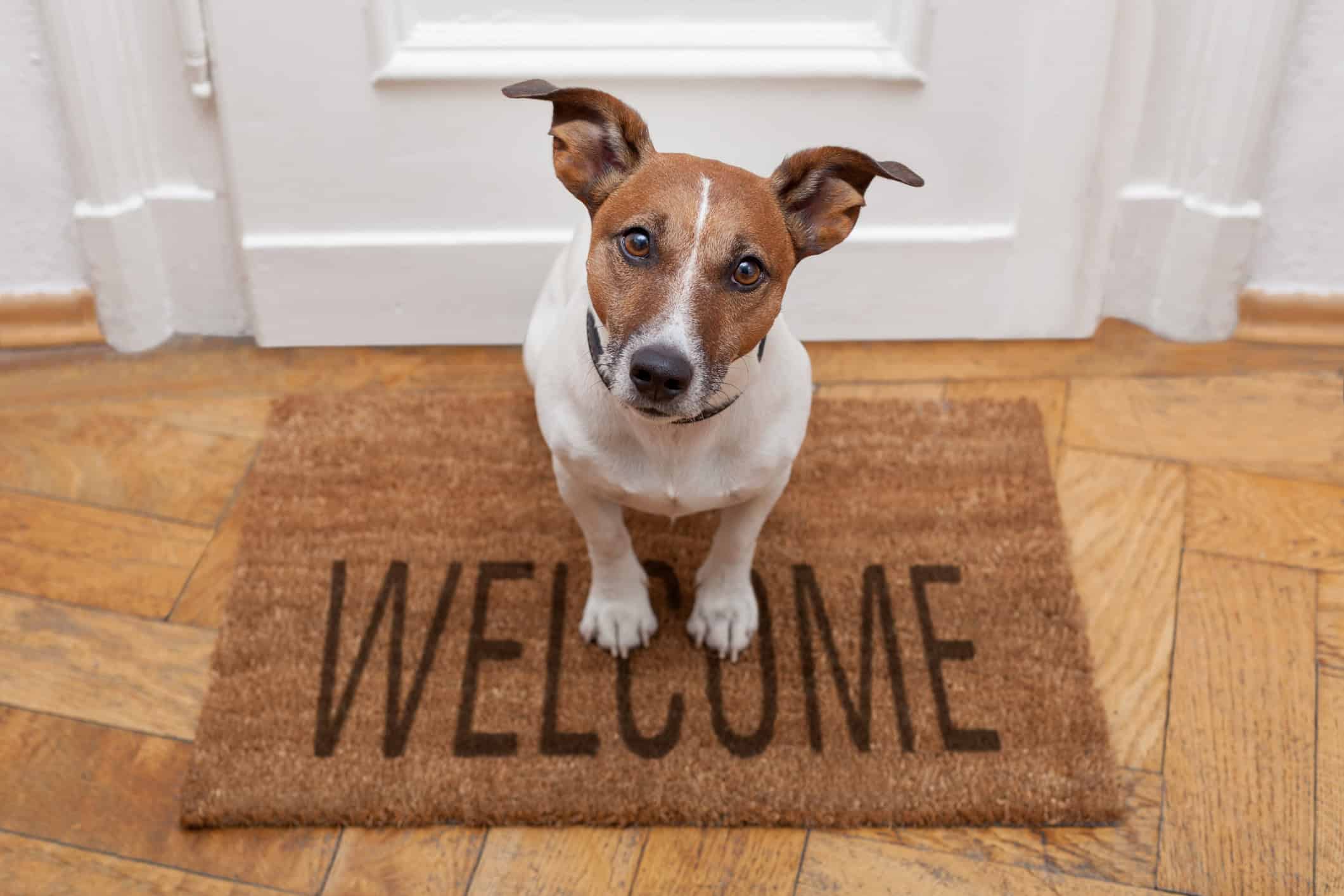
The owners of this problem pooch lived in a beautiful home with a two car garage. They almost always entered the home from the door located in the garage. This left the main door available for visitors. Therefore, the terrier became used to the fact that her owners always came in the garage door and “strangers” always entered the main door. So I had the owners begin using the main door as their new means of entering the house……what a surprise for our temperamental terrier! We also incorporated methods of making the dog understand that people using the main door were just as friendly as her owners. In no time, our terrier went from barking and tearing at the door to sitting tranquilly awaiting visitors to pet her.

Now, our owner is able to take her cordial canine friend for uneventful strolls around the neighborhood and the days of those action-packed walks are long gone. She is also able to answer her door without the concern that her dog may bite someone. The difference in this terrier is remarkable and was accomplished in only six-weeks.

If you would like to discuss training or how we can assist you in eliminating behavioral problems please call 866.200.2207 or email training@highlandcanine.com

It’s 3:21 a.m. and you arrive on-scene with your dog. It’s muggy and damp outside and they have a 45 minute head start. The eyewitness tells you that they were last seen heading south past the tree line. You harness your partner and prepare to track. Your dog gives you every indication that they headed north….What Now? This question often arises among handlers….If an eyewitness indicates that the victim/suspect ran south, but my dog says that he went north, which way do I go?

Eyewitnesses can provide very valuable information and detail. Unfortunately, eyewitnesses often give incorrect information. In most cases, eyewitnesses do not intentionally give wrong information. Often they remember things that didn’t happen or see things in a perspective other than what actually occurred. People often remember events in a manner that fits with their own expectations for a situation.

If you work a police tracking dog or are a search and rescue dog handler, you could feasibly be presented with similar circumstances. If this situation ever happens to you there are several questions that you should ask yourself before you proceed.

The first question is “Do I trust my dog?” This question should always be answered honestly. If you lack confidence in your dog, you will likely make costly mistakes. Even a highly skilled tracking dog can be very ineffective with a doubtful handler following. If you don’t have the confidence that you should in your dogs’ ability to successfully negotiate the track ahead of you, more training should be in your future. Only productive training will build your confidence in the abilities of you and your dog as a team. If you are an inexperienced handler or are unsure of your dogs’ capabilities, you should refer the task to a more experienced team, if possible.

The second question is, “Based on previous experience and training is my dog capable of handling this?” If you have handled the dog for any length of time you should be able to quickly determine the answer to this question. For instance, if the suspect/victim has been gone for four hours, you should consider whether or not your dog is capable of successfully following a trail that is four hours old. If your dog is in fact capable of following trails of this age, then you should consider whether or not your dog is able to effectively pursue an aged track through the contamination that you are presented with in this circumstance. You should also consider other factors that may present themselves during the track. If you know that you will likely be required to track across asphalt or other hard surfaces, ask yourself; “Will my dog track efficiently on hard surfaces?”

If you answer all of the questions presented affirmatively, follow your dog and keep up the good work. If not, more productive training in tracking should be on your agenda.

If you would like to discuss training problems or schedule a tracking seminar, please call 866.200.2207 or email training@highlandcanine.com

Canine Academy

February 5th, 2010

Jake really loves his work. He throws himself into it with a ferocity and single-minded determination that is impressive to watch. And he doesn’t ask for very much in return – just a scratch on the head and a biscuit from his partner, Sgt. Jeff Sharpe of the Alexander County Sheriff’s Office.

Jake is a 2-year-old German shepherd police dog donated to the Sheriff’s Office by his trainer, Jason Purgason of Highland Canine Training in Harmony. With a background in dog training and nearly 10 years’ experience as a canine officer in Reidsville, Purgason specializes in preparing well-rounded police dogs that are highly skilled in narcotics and explosives detection, tracking and apprehending offenders.

What makes a top-notch police dog?
“It’s all about genetics,” Purgason says. “You have to breed for prey drive, the natural instinct to chase and catch. It’s what we use to teach dogs to hunt for something that’s out of sight.”

A variety of breeds are used in police work. German shepherds, Labrador retrievers and bloodhounds are common. Mixed breeds also can make excellent police dogs, and small size doesn’t necessarily preclude a dog from this kind of work.

Weeks of training
Training for police work typically begins when the dog is a year old and takes 12 to 14 weeks. Training the handler takes another four weeks.

“That’s the hard part,” Purgason says. “Police officers are visual creatures and they’re skeptics. You’ve got to teach them to believe in something they can’t see.”

When the active training period ends, the maintenance phase begins. The dog’s training continues on the job and in daily practice sessions with his partner. To keep Jake at the top of his game, Sharpe works with him every day, hiding drugs for the dog to find or directing him to search for a weapon hidden in a field. Once a week he takes Jake to “bite training” sessions at Highland Canine. During these practice sessions, Jake chases a decoy – trainer Purgason – and attacks the heavily padded bite shield on Purgason’s arm, immobilizing the man until Sharpe calls him off.

Keeping Jake’s training up to date pays off on the job. The dog recently found a stash of cocaine and cash hidden in a stereo in a suspect’s home. As the first K-9 unit in their county, Jake and Sharpe are definitely making a name for themselves.

Creating good citizens
Training police dogs is not the only service offered by Highland Canine. The staff recently launched the Second Chance Program to help rehabilitate shelter and rescue dogs that have serious behavior problems, such as aggression toward humans or other dogs, phobias, dominance or separation anxiety. Without rehabilitation, these problem dogs might not find homes and probably would be put down.

“We want to work with dogs who would probably be euthanized if their problems weren’t resolved,” Purgason says.

Training of Second Chance dogs takes anywhere from three to six weeks, longer if necessary. All training is done one on one rather than in groups.

Bear, a border collie mix, was the first dog to go through the program. He was referred by the Cornelius Animal Shelter, where Katy Stokes works as a volunteer. Stokes is also an apprentice at the Highland Canine center. Other staff members include Corrie Roberts of Mooresville. Erin Purgason, Jason’s wife and a full-time detective sergeant with the Iredell County Sheriff’s Office, owns the training center.

Bear was very aggressive and tried to attack anyone who approached. The first step in changing this behavior was to determine its root cause.

“In Bear’s case, the problem was that he had no structure, discipline or direction,” Jason Purgason explains. “He was bored in his environment, so he made a game of guarding things and chasing after and biting people.”

Purgason and his staff taught the dog new things to do with his time, such as obeying commands to “sit,” “down,” “stay” and “heel.” To reward good behavior, they used a combination of treats, petting and verbal praise.

After several weeks of training, Bear was a new dog.

“He seems very content now,” Stokes says. “Before, he was always looking for something to terrorize.”

The next step will be to find a good home for Bear.

“We’ll try to look for a family that can burn some of his energy,” Purgason says. “We wouldn’t place him with someone who lives in a small apartment. We try to match the dog’s personality and the adoptive family’s lifestyle.”

The root of dog problems
Behavior problems in dogs can usually be traced to one source – people.

“People are responsible for 95 percent of the bad behaviors dogs have,” he stresses. “They do this by inadvertently rewarding wrong behavior or spoiling dogs so that the animals get the idea they’re in charge. We see a lot of owners whose personalities or lifestyles don’t mesh with their dogs.”

Although she didn’t come through the Second Chance Program, Jessie is a good example of a dog with a behavior problem. Ashley and Linda Page of Davidson decided to adopt the young boxer mix after they found her running loose along a Mooresville highway.

When they took her home, it soon became obvious that Jessie had been abused. She wouldn’t have anything to do with Ashley Page or with men in general. She was very fearful and refused to walk on a leash even after 10 months of training.

Ashley Page called on Purgason for help. The trainer went to the couple’s home and showed them how to teach the dog basic obedience and use food rewards to motivate her.

“It was an education,” says Page. “By the end of the first session, Jessie walked on a leash. For six weeks she learned to heel, sit and stay. We worked with her every day. By the end of that time she was a different dog. She’s still a little skittish with strangers, but we’re seeing steady progress.”

Purgason taught Page to use a hand signal for the command “come” in conjunction with a voice command. Now Jessie comes to her owner every time without fail. All traces of fear and avoidance are gone.

“It’s very rewarding,” says Page. “I can take Jessie to the store, I can walk her in downtown Davidson. She’s become a real good dog.”

The Third Time Is A Charm

February 5th, 2010

A lot of great things come in twos; twins, grandmothers, and even flip-flops. There are also a lot of great things that come in threes, fours and other multiples. However, obedience commands are not one of them. Repeating obedience commands to your dog sends the wrong message and can quickly erode good behavior.

For example, you are out walking your dog through the neighborhood and he is heeling alongside of you, just as he should be when all of a sudden you see your neighbor heading toward his mailbox. So you decide to go over and say hello. You have worked diligently to teach your dog obedience and you are so proud of what you have accomplished. You determine that this may be a good time to “show off” a bit. You are talking with your neighbor and your dog becomes a bit restless, you tell your dog to sit…he refuses. Again, you tell your dog to Sit! Again, he refuses. On the third attempt you tell your dog to sit and promptly correct him. Your dog sits promptly and looks up at you confused.

Now let’s think for a minute. What has your dog learned? Your dog has learned over a series of commands to sit patiently until you tell him to sit three times and that if he does not sit after the third time he will be corrected. Therefore, he will generally anticipate the correction and sit promptly after you tell him…..for the third time. This method however, defeats our purpose.

Unfortunately, I have seen a great number of pet training clients as well as police dog handlers make this, all too common, mistake. If our dog does not sit the first time, we automatically say the word again and sometimes even again. Then, you complain that the dog is lazy or stubborn when really the dog is simply doing what he has been conditioned to do. The most ironic part of this entire exchange between you and your dog is that both participants are convinced that the other is wrong.

Sit means Sit! Sit does not mean sit after I tell you twice, three times or even four. Sit means that I will tell you once, very clearly, to sit and then you will sit. Sit is not optional. Unfortunately, I find that the dog is often trained incorrectly and the dog will respond “inappropriately”. We view sitting after the third command “inappropriate” but this is the response that we have conditioned our dog to. Repeating obedience commands is a very difficult habit to break. It is much easier to never start. If you already have this problem have a friend, or better yet, a professional trainer listen observe while your train with you dog. You will often be surprised to find that they will notice you repeating commands even when you thought you only said it once.

One of the most important principles of training a dog, whether it is a personal pet or a police patrol dog, is consistency. We must be completely consistent in everything that we do with our dog. If we tell our dog to sit once and correct him if he does not he will soon understand that a correction soon follows after “Sit” is said the first time. Then our dog will promptly sit after our command in order to avoid the correction. After all, having our dog sit after we give the command is the result that we are all looking for.

If you would like to discuss training problems or schedule a consultation, please call or email training@highlandcanine.com

Talk To The Hand

February 5th, 2010

I recently had the pleasure of working with a couple in Davidson, North Carolina who wanted some training for a dog that they had rescued. They stated that the dog was found abandoned and they took it in, not knowing her history. The dog, Jessie, was a beautiful boxer/mix and was, I believe, 7-8 months old when they got her. The couple had the dog for some time before contacting me.

The gentleman called and stated that they wanted some general training for the dog. He explained that the dog was quite fearful and especially had a problem with men. He stated that she would growl, bark and run away anytime that new people, especially men, came to their home. He also stated that the dog would come to his wife when called but would not come to him at all.

I went to their home to begin teaching them how to train their dog. When I arrived, the dog began barking, growling and running from me. It was apparent that this phobic rescue had an issue with men.

Over the following weeks, our work with this dog seemed to be paying off. She had learned to sit, down, stay and heel on a leash and she was much better when meeting new people. However, coming was a bit of a different story. She would come, when on a leash, reluctantly. Jessie would come to me and the wife but for some reason would not come to him. We discussed the situation and the problems that he’d had previously with the dog coming to him and he explained that this was his biggest issue. I explained to him that because she was a rescue and he didn’t know her history, it was likely that she had some negative association with the come command in the past. After some more work and motivational games with Jessie, she began to come to the owner more consistently on the leash.

We began off-leash training with Jessie and knew that getting her to come when off the leash would be a challenge. I talked with the owner again and we discussed some possible reasons that she was reluctant to come to him. It came to light that there was a considerable amount of doubt, on his part, that the dog would actually come when called. He had spent all these prior months trying to get the dog to come to him to no avail. Therefore, he had it in his mind that when he called Jessie, that she was not going to come. This explains why Jessie would come to his wife and me consistently. We both had no preconceived notions about whether or not she would come to us because she had always done so.

I explained to the owner that Jessie was likely picking up on the doubt in his voice when he called her and the he should attempt to forget about all of the times in the past that she had not come when called. He worked on doing this for a while but we still did not see the results that we were looking for.

We began working on teaching Jessie the hand signal for the come command and something magical happened! All of a sudden, Jessie would come to the owner consistently, when given the hand signal. By using a hand signal for the command, we were able to accomplish a number of things. First, we were able to eliminate any previous negative associations that Jessie had with the word come. Second, we were able to give the owner a method of calling Jessie without her being able to read any doubt in his voice inflection. It was an infallible method of calling her.

After working with Jessie on her hand signals for several weeks the owner was happy to report:

“…went to the dog park in Cornelius and there were 6 to 8 dogs there. They were all together in a pack and I was 40-45 yards away. I called Jessie’s name (not loud) – she looked – and I gave her the hand signal for come. She came right over. Over the period of an hour I did it three times – all successful. She only had on the nylon collar. For me that was like an acid test for the hand signal. I had never attempted it in any situation like that.”

If you would like to discuss training or how we can assist you in eliminating behavioral problems please call 866.200.2207 or email training@highlandcanine.com

Talk to the Hand….

An old adage holds that “Those who do not learn from history are bound to repeat it.” I find that this unfortunately is the case among too many police dog handlers. This “history” that I refer to is case law that applies to the police working dog team. Canine case law deals with many issues, from the Fourth Amendment to the Fourteenth Amendment. If we study it, it will explain to us when, where and how we can more effectively utilize our police canines. I find that generally, there are two basic problems with those who do not take the time to research and study case law.

First, are those who do not understand what the courts have decided in certain cases and they make the same mistakes that have been made in previous cases. In these instances, their cases are dismissed, criminals go free, or they find themselves and their department in the middle of a lawsuit.

Secondly, are those handlers who do not understand previous rulings and do little or nothing. These handlers commonly do not properly utilize their canines because they do not want to make a mistake. They do not understand what they can do with their dogs and do not want to make the wrong decision. Therefore, they do not utilize their canines or they under utilize them.

Another issue that I have observed in my dealings with district attorneys and prosecutors is that they often must handle many different types of cases, from murders to forgeries. Canine related cases are much fewer and far in between as compared to all of the other cases that they deal with. Therefore, they are often spread thin and unfortunately canine cases do not land high upon their rankings of cases that they are adequately prepared for. On the other hand, defense attorneys generally have more time to spend with individual cases. Some of them often specialize in certain areas, one of those being canine related cases. This can often cause an unbalanced court preceeding for and ill prepared canine handler.

Should you be able to recite, word for word, United States v. Place? No. That is not what I am suggesting at all. However, I do feel that you will be better prepared and more confident on the stand if you are capable of citing that United States v. Place was the 1983 landmark Supreme Court case that stated that “a canine sniff is not a search” By being able to establish this in court you will be able to give a judge, prosecutor and defense attorney something to “study” and make your case easier to prosecute successfully.

I feel that every law enforcement officer that handles a police canine should be well versed on the case law and court decisions that affect them. I highly recommend meeting with your prosecutor prior to trying canine related cases and discuss with them the previous decisions that affect your case. By studying case law and better understanding it, you will be able to work your dog on the street with confidence. You will be more capable of making sound, split second decisions and capable of “pushing the envelope” within the law. Your will be more successful and far more productive when you fully understand what you can and cannot do with you dog.

If you would like to discuss how our Police Canine Case Law Seminar may benefit your department and receive a free copy of Case Law Reference for Police Canine Handlers, please call us or email us at jpurgason@highlandcanine.com

Highland Canine Training, LLC will be holding another FREE dog behavior seminar on March 15, 2010 at 6 p.m. at Troutman Elementary School (Media Center) located at 220 S. Main Street, Troutman, NC 28166.

This seminar is a great opportunity for dog owners, veterinarians, rescue volunteers, petsitters, groomers and others to learn about canine communication, canine cognition as well as answers to some common myths and questions about dog behavior. The seminar will last for about 3 hours and will include about an hour question and answer session with our training staff.

The seminar will include such topics as:
How Dogs Learn
Canine Body Language
Behavior Problems
How to be a Better Dog Owner
Bite Prevention
Working with Dogs and Children
…and much, much more!

This seminar is free of charge and is open to anyone who would like to attend. Space is limited and registration for the seminar is required. If you would like to attend the seminar, please email us at training@highlandcanine.com. Please include your name and phone number in your email. Our recent seminar posting for Charlotte filled in about a week. If you have questions about the seminar, feel free to call us at 704.728.9494.

Of the 16.6 million illicit drug users aged 18 or older in 2002, 12.4 million (74.6%) were employed either full or part time. These employees are costing American businesses billions of dollars annually in lost productivity and health care costs. Due to higher employment rates and rising substance abuse, the chances that your organization employs one of these 12.4 million workers is greater today than it has been in the past several years. Studies reveal that employees who abuse drugs have a tremendously harmful effect on the workplace—they are more likely to have extended absences from work, show up late, be involved in workplace accidents, and file workers’ compensation claims.

Highland Canine Training, LLC offers private detection services for businesses, schools, and private homes. This service allows private businesses to determine whether their facility has an issue with employees using illegal drugs at their workplace. This service also allows companies the opportunity to take a proactive approach to this increasing problem without the initial presence of local law enforcement. Drug detection services allow the employer to promote a Drug Free Workplace as well as providing an unmatched psychological deterrent.

Highland Canine Training, LLC offers teams that are capable of searching residential and commercial structures as well as motor vehicles. Our top-quality dogs are able to easily search a multitude of areas and objects and can detect the odor of illegal narcotics effortlessly. Our narcotics detection dogs are trained to locate the odor of Marijuana, Methamphetamines, Cocaine HCL, Crack Cocaine, Heroin and derivatives.

Our services can be contracted monthly, quarterly, semi-annually or you can be placed on a “will-call” status. These detection sweeps are coordinated with the appropriate company personnel and can be scheduled to suit your company’s needs.

Our handlers and employees are discreet and are held to the utmost confidentiality. We can assist you in implementing an effective plan for properly conducting these random searches within your business. With proper planning, these searches are often very effective and have little or no impact on the day-to-day workflow of your business. In some cases, these searches can be conducted in a manner that most employees never knew that they occurred.

Cost for our services is calculated based on a number of factors including but not limited to:

Size of facility
Area of facility to be covered
Number of employees
Vehicles to be searched (if any)
Scheduling (recurrent scheduling is at a reduced rate)

Highland Canine Training, LLC welcomes the opportunity to visit your facility and provide you with a detailed quote before services are contracted. Our services are very affordable and can easily fit within your budget. For example, a company with 100 employees would spend an average of $50 per employee to have them randomly drug tested once per year. This comes to a cost of $5,000 per year to drug screen each employee only once.

By utilizing detection dog services, the same company, with 100 employees could have their entire business screened once a month for an average cost of $200 per visit, totaling $2,400 per year. Therefore, the employer could have their employees and business screened twelve times more at a savings of $2,600 per year for the employer.

Some businesses are also eligible for insurance discounts when they initiate a proactive drug free workplace program. Check with your insurance provider for available discounts.

Highland Canine Training strives to offer the most professional and effective detection services available. A majority of our handlers are former or current law enforcement handlers. We provide discreet and confidential services for our clients at reasonable rates. You can learn more about our staff and facilities at our website. If you have questions or need more information, please feel free to contact us toll-free at .866.200.2207 or locally at 704.728.9494.

Proudly powered by WordPress. Theme developed with WordPress Theme Generator.
Copyright © Highland Canine Training, LLC. All rights reserved.